






 Trap
 Normal
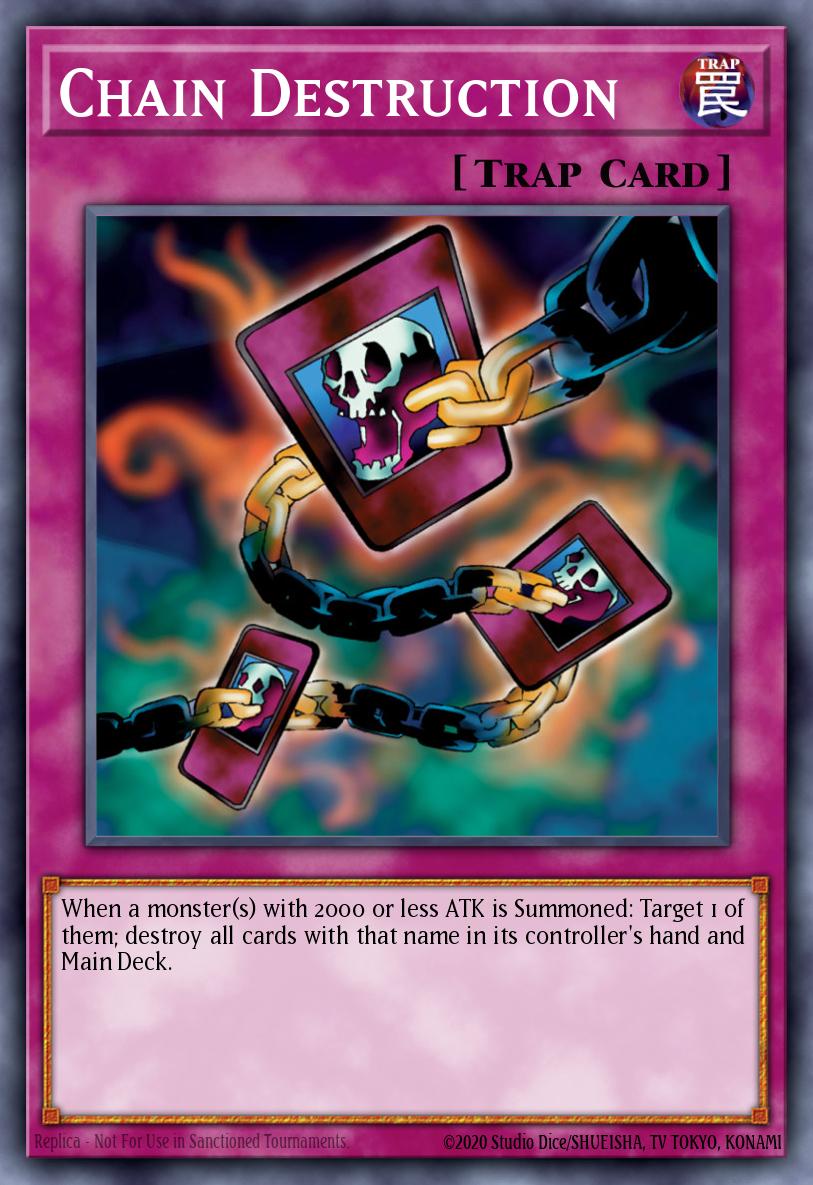
Chain Destruction
View:
5506
When a monster(s) with 2000 or less ATK is Summoned: Target 1 of them; destroy all cards with that name in its controller's hand and Main Deck.
Chain Destruction — Power Evaluation
Final Score: 55 ± 8 · Confidence: Medium
- Intrinsic: 55 · Deck: 56 · Meta: provisional
- Primary role: Removal / Negation · Secondary: Floodgate/Control
Why it scores here
Chain Destruction is a reactive Normal Trap that, when it is set and a monster with 2000 or less ATK is Summoned, destroys every copy of that name in the opponent's hand and Main Deck, so its value is one targeted disruption that can also hit multiple copies. It does not build a board, does not negate effects, and has no material value, so those axes stay low. Its 100-deck presence across 43 archetypes shows it is portable and easy to run, but that sample was selected by the card itself, so the 100% inclusion figure is not treated as evidence of strength. The score is held to the mid-50s because the interaction is strong but conditional on the opponent summoning a monster in range and on set-trap timing.
Axis scores
| Axis | Score | Evidence |
|---|---|---|
| Accessibility | 55 | Needs to be set in a spell/trap zone before the summon window, and no combo or searcher data is supplied, so it is live only when already set (inference from text; deck count 100/100 is a selection artifact of the sample). |
| Combo & Conversion | 20 | Reactive trap that builds nothing on its own, and there are zero recorded combo boards, so conversion is text-only (inference from text; no combo evidence). |
| Resource Economy | 55 | Costs one card to set and can destroy several copies of one name across hand and deck, a possible multi-card swing but only against one name (inference from text). |
| Effect & Interaction | 50 | Strong destruction on a summon window, limited to monsters at 2000 ATK or less and by name, with no negation of effects (verified from card text). |
| Material Utility | 0 | A trap card with no monster body, so it cannot be used as material (verified from card type). |
| Resilience & Flexibility | 45 | Vulnerable to having the set trap destroyed or negated before the summon, though multi-copy use gives some redundancy across 1.7 average copies per deck (observed deck copies; inference for the interaction risk). |
| Deck-Building Efficiency | 70 | A single trap slot with no garnet or lock restriction, and copies of one name are redundant by design (verified from text and deck copy distribution; no banlist token supplied). |
Calculation
Weight profile: Removal / Negation primary (0.7) blended with Floodgate / Control secondary (0.3). Intrinsic ≈ 55, Deck ≈ 56, Meta = provisional. Modifiers: none. Final formula: 0.40*Intrinsic + 0.60*Deck
Strengths
- Strong, flexible destruction that hits both hand and Main Deck copies of a name
- Portable across many archetypes with easy, low-cost slot use
- No garnet or self-locking restriction
Weaknesses
- Conditional on the opponent summoning a monster at 2000 ATK or less
- Does not negate effects, so its impact depends on the summon being removed rather than stopped
- No material or board-building value
Counters / choke points
- Trap destruction or negation before the summon window
- Summoning monsters above 2000 ATK or using non-Summon routes
- Playing around the set trap by sequencing summons
Best use
Reactive removal trap against low-ATK summon-based lines. Decks: Fire King, Yubel, Fire Fist, Charmer, Snake-Eyes, Diabellstar, Blue-Eyes. Suggested copies: 1.
Evidence & gaps
- Verified: Card text: destroys all cards with the chosen name in the controller's hand and Main Deck when a monster with 2000 or less ATK is Summoned; Card type is Trap Card, so it has no monster body or material value; Appears in 100 of 100 sampled decks across 43 archetypes with average 1.7 copies
- Observed: Top partners include Infinite Impermanence, Droll & Lock Bird and Dark Hole in roughly 55 to 66 percent of sampled decks; Copy distribution is 51 decks at 1 copy, 28 at 2 and 21 at 3
- Inferred: Summon-window timing makes it reactive and needs it set beforehand; Interaction strength is conditional on the summon being in the 2000-ATK-or-less range; Sample inclusion is selection-biased because decks were chosen by containing the card
- Data gaps: no combos supplied, so combo conversion and starter/material roles are text-only inference no guides supplied no usage statistics (StatisticsCard), so archetype inclusion is inferred from the deck sample only deck sample is selected by the card itself, so 100% running main is not a real inclusion rate no banlist token supplied; assumed 3 copies (unlimited) card race is listed as Normal; trap subtype taken as Normal Trap from text